
AI scoring transforms sales prospecting by analyzing vast amounts of data in seconds to identify high-priority leads. Unlike traditional manual scoring, which is slow and prone to error, AI-powered systems continuously learn from outcomes, improving accuracy and adapting to changing market conditions. This approach saves time, eliminates bias, and ensures sales teams focus on the most promising opportunities.
Key insights from the article:
- Time savings: AI-powered tools cut research time by up to 60%.
- Increased engagement: Companies report a 35% improvement in prospect engagement rates.
- Better lead prioritization: AI scoring boosts pipeline growth by 10–25% and leads to faster responses.
- Scalability: Handles large lead volumes without slowing down.
The SIMPLEST Way To Build An AI Lead Scoring Assistant (AI Automation)
What AI Scoring Is and How It Works
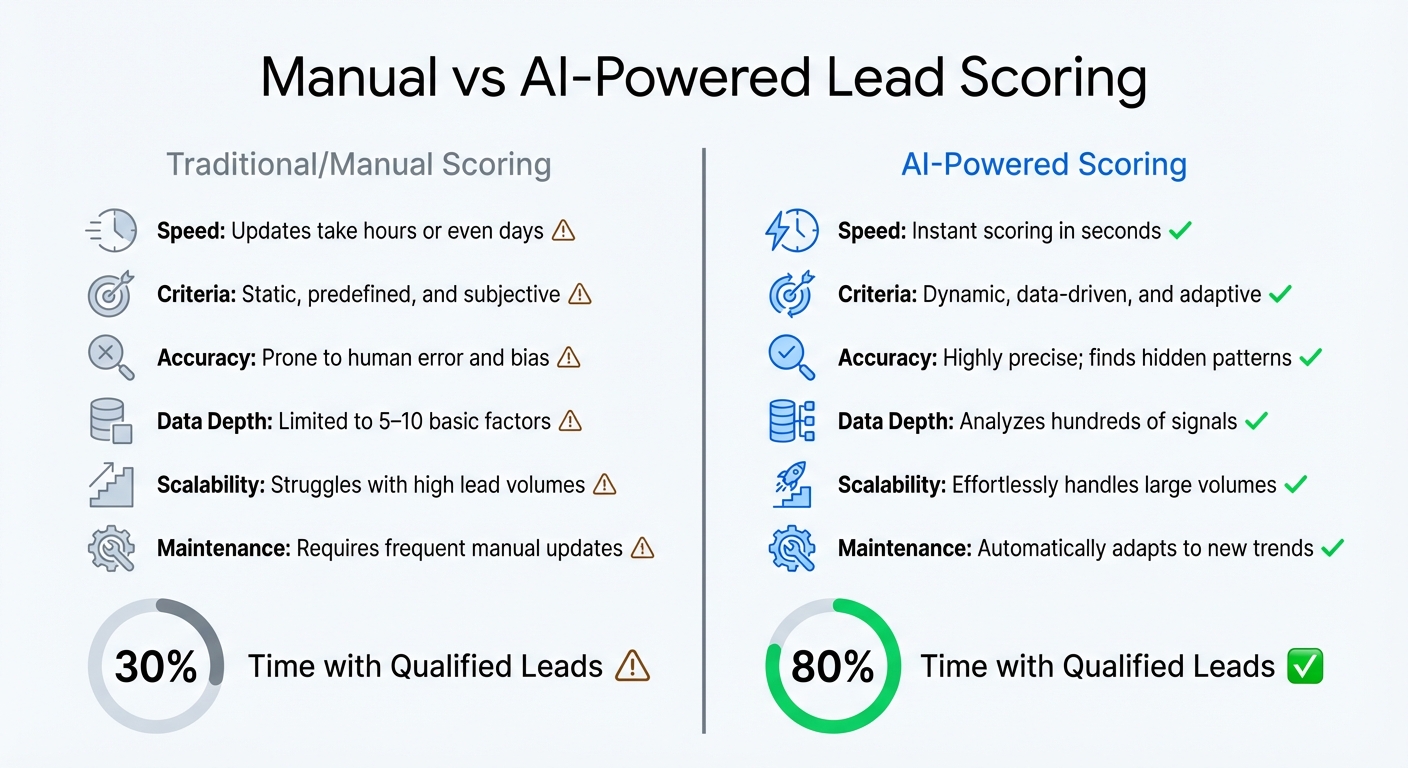
Manual vs AI-Powered Lead Scoring Comparison
AI Scoring Explained
AI lead scoring is an automated system that uses machine learning to rank prospects based on their likelihood to make a purchase. Unlike traditional methods that rely on limited, static criteria, AI taps into hundreds of data points – things like job titles, company size, website activity, email interactions, sentiment from call transcripts, and even mobile page load times – to evaluate and rank leads.
Here’s how it works: First, it gathers data from sources like your CRM, website, and engagement platforms. Next, it identifies patterns by analyzing trends from past successful deals. Then, it assigns each prospect a predictive score that reflects their probability of conversion. Finally, it routes high-potential leads to the right sales reps automatically. The best part? The system gets smarter over time. Every closed deal – whether it’s a win or a loss – feeds back into the model, fine-tuning its accuracy without requiring manual updates.
In outbound prospecting, AI scoring provides real-time insights, helping sales development representatives (SDRs) know exactly when to reach out to a lead. It doesn’t just suggest actions – it backs them up with data. For example, it combines explicit information (like job titles and company revenue) with implicit signals (such as LinkedIn activity or browsing behavior) to give SDRs a clear picture of a prospect’s readiness to buy. This sets AI scoring apart from traditional methods, which we’ll explore next.
Manual Scoring vs. AI Scoring
Manual lead scoring relies on fixed rules – assigning points for specific factors like job titles or industries. This approach typically considers only a handful of criteria, usually around 5–10, and requires constant updates to remain relevant. On the other hand, AI-driven scoring is dynamic and self-adjusting. It continuously learns from new data – wins and losses alike – to refine its scoring in real time.
| Aspect | Traditional/Manual Scoring | AI-Powered Scoring |
|---|---|---|
| Speed | Updates take hours or even days | Instant scoring in seconds |
| Criteria | Static, predefined, and subjective | Dynamic, data-driven, and adaptive |
| Accuracy | Prone to human error and bias | Highly precise; finds hidden patterns |
| Data Depth | Limited to 5–10 basic factors | Analyzes hundreds of signals |
| Scalability | Struggles with high lead volumes | Effortlessly handles large volumes |
| Maintenance | Requires frequent manual updates | Automatically adapts to new trends |
Manual scoring can’t keep up with the demands of modern prospecting. It’s slow, rigid, and struggles to handle large lead volumes. In contrast, AI scoring operates at lightning speed and scales effortlessly, making it a game-changer for sales teams.
Why AI Scoring Improves Prospecting
AI scoring brings three standout benefits to prospecting: speed, accuracy, and objectivity. It processes thousands of leads in seconds, allowing your team to respond to high-priority prospects almost immediately. By using consistent, data-driven logic, it eliminates human bias and uncovers insights that might otherwise go unnoticed – like how visiting a specific page on your website correlates with a higher chance of conversion. This means your team can focus 80% of their time on qualified leads, compared to just 30% with manual methods.
Another advantage is scalability. Whether you’re dealing with 100 leads or 10,000, AI scoring applies the same rigorous analysis across the board without any slowdown. That level of efficiency ensures your team can handle growing lead volumes without missing a beat.
Getting Your Data Ready for AI Scoring
Checking If Your Data Is Ready
Before diving into AI scoring, make sure your CRM checks three essential boxes: volume, diversity, and structure. Most AI scoring systems need a solid base of at least 100 to 200 historical leads with clear outcomes – both wins and losses – to start identifying patterns effectively. Without this minimum, the system won’t have enough data to differentiate between high-priority prospects and others.
Your dataset should include three main types of signals: demographic (like job titles and seniority), firmographic (such as company size, revenue, and industry), and behavioral (think website visits, email engagement, or content downloads). Missing any of these categories can reduce the AI’s ability to make accurate predictions. Also, ensure all your data is centralized. If customer details are scattered across spreadsheets, marketing platforms, and your CRM, consolidate everything into a single, unified system before moving forward.
"AI isn’t plug-and-play – at least not if you want it to drive real results. Getting your customer data ready is step one." – Alex Breya, Leadspace
Another key step is labeling historical outcomes clearly as "Won" or "Lost". Once that’s done, audit your CRM thoroughly to remove duplicates and verify the accuracy of your data.
How to Audit Your CRM Data
After centralizing and organizing your data, it’s time to audit your CRM to ensure it’s clean and reliable. Start with a duplicate check. Duplicate records can confuse AI systems, leading to inaccurate predictions and poor prioritization. Use automated tools to identify and merge duplicates that could disrupt the AI model’s learning process.
Next, focus on Lead-to-Account (L2A) matching. Each lead must be correctly linked to its parent account so the AI can analyze the entire buying committee instead of treating contacts as standalone entities.
Check for missing or outdated information. CRM data has a tendency to age quickly – studies suggest 30–40% of it might already be outdated, which could impact your AI’s performance. Look for gaps in critical fields like job titles, company names, industry details, and revenue data. Third-party data providers can help fill in these blanks, especially for firmographics and technographics. Also, ensure all data fields follow standardized formats so the AI can detect patterns consistently.
Outdated firmographic details or intent signals can quietly derail predictions. To avoid this, schedule quarterly audits to remove stale information. B2B data changes fast, so regular updates are crucial. Finally, set up clear data governance rules. Define who is responsible for maintaining data quality, how information should be collected, and how it will be managed going forward.
How to Build and Deploy Your AI Scoring Model
Building and deploying an AI scoring model can transform how you approach prospecting, making it more efficient and data-driven.
Define Your Ideal Customer Profile (ICP)
Start by analyzing your closed-won and closed-lost deals to identify what sets your best customers apart from those who weren’t a good fit. Focus on four main categories:
- Firmographics: Industry, company size, revenue, and location.
- Technographics: Tools and platforms your prospects already use.
- Demographics: Job titles, departments, and the seniority of decision-makers.
- Behavioral Signals: High-intent actions like visiting pricing pages or attending webinars.
To keep things manageable, align your sales and marketing teams on 5–10 key attributes to track, rather than overloading with too many variables. Also, incorporate negative scoring by deducting points for red flags like student email addresses, competitor domains, or leads from regions outside your service area.
Here’s an example: In December 2024, Fivos Aresti, co-founder of Workflows.io, used AI to narrow down a massive list of 66,000 potential SaaS companies to just 5,700 VC-funded HubSpot users. By segmenting these accounts into a "Dream 150" for personalized outreach and using automation for the rest, the company hit $1M ARR in just three months.
Once you’ve defined your ICP, the AI model will quantify these attributes, turning them into actionable scores.
How the Scoring Model Works
AI scoring assigns numerical weights to each attribute based on how strongly it predicts conversion. For example, higher weights might be given to senior-level titles at larger companies. Unlike humans, who can only focus on a handful of factors, AI can analyze hundreds of data points simultaneously.
The model doesn’t stop at assigning scores – it also creates thresholds to guide actions. High-scoring leads might be routed directly to Account Executives, while mid-range leads could be placed in nurturing campaigns. For instance, one software company saw a 27% boost in sales by automating prospect research and concentrating efforts on high-scoring leads.
Additionally, the AI model provides insights into what drives each score, helping sales reps tailor their outreach.
"AI lead scoring typically outperforms manual methods by a significant margin. While humans might consider 5–10 factors when scoring leads, AI analyzes hundreds of data points simultaneously." – Apollo Team
Adding the Model to Your CRM
Once your scoring model is ready, the next step is integrating it into your CRM to ensure seamless updates and actions. Use bi-directional sync to keep scores current and trigger workflows automatically. Map the AI-generated scores to specific CRM fields. For example:
- Salesforce users often use the "Status" picklist.
- HubSpot users might map scores to "Lifecycle stage" or "Lead status."
Your CRM then becomes the command center, pulling in data from website analytics, email engagement tools, and third-party enrichment platforms to keep the model updated.
Set up workflows in your CRM to act on score thresholds. For instance, configure real-time alerts to notify sales reps when a prospect’s score crosses a high-intent threshold. To maintain accuracy, schedule regular reviews (e.g., monthly) to incorporate closed-won and closed-lost data back into the AI model. This feedback loop helps prevent the model from drifting and ensures it stays aligned with your business goals.
sbb-itb-647c22e
Connecting AI Scoring to Your Sales and Marketing Workflows
Once you’ve integrated AI scoring into your systems, the next step is to put it to work. Use these scores to automate lead routing, tailor your campaigns, and refine your model over time. Here’s how you can streamline these processes for maximum impact.
Automate Lead Routing and Prioritization
AI scores are most effective when they guide instant decisions, ensuring leads are sent to the right teams at the right time. To make this happen, set up CRM rules based on score thresholds. For instance, leads with scores of 80 or higher should be routed immediately to an Account Executive. Why the urgency? Companies that respond to leads within an hour are seven times more likely to engage decision-makers than those that delay.
Take the example of Fivos Aresti, co-founder of Workflows.io. In late 2025, he scaled the company to $2M ARR using a tiered outbound strategy. By leveraging tools like Clay and ChatGPT, they scored 66,000 potential accounts and narrowed them down to 5,700 qualified leads. These were divided into four tiers: the "Dream 150" for manual LinkedIn outreach, Tier 1 for immediate cold calls, and Tiers 2 and 3 for fully automated email and LinkedIn sequences. This method allowed his team to focus resources where they mattered most.
It’s also critical to make contextual data easily accessible in your CRM. As Personize Studio puts it:
"A lead score must do three things within minutes: 1) show why the prospect is worth calling now; 2) supply short evidence the rep can use on the first touch; and 3) trigger the exact HubSpot action – task, routing, or sequence".
Use AI Scores to Improve Nurture Campaigns
AI scoring can transform how you nurture leads by enabling intent-based segmentation. For instance, mid-scoring leads (50–79) can be placed in workflows tailored to their engagement level. High-intent leads might receive weekly educational content with clear calls-to-action, while lower-intent leads could be sent monthly newsletters to keep your brand in their minds without overwhelming them.
Lead nurturing done right can have a major impact – companies that excel in this area generate 50% more sales-ready leads while cutting costs by 33%.
Negative scoring is another valuable tool. For example, you can deduct points for behaviors like visiting career pages or using generic email addresses. Leads with lower scores can then be moved to low-touch marketing tracks, ensuring your team focuses on prospects more likely to convert.
Update Scores in Real-Time With Feedback Loops
AI scoring models thrive on real-time updates and feedback. Set up triggers that adjust scores instantly based on high-intent actions, such as visiting pricing pages, attending webinars, or interacting with emails. If a lead in a nurture track suddenly shows a spike in activity, they can be seamlessly transitioned from marketing to sales outreach at just the right moment.
To keep your scoring model sharp, feed it with closed-won and closed-lost data regularly. Schedule monthly meetings with RevOps, Sales, and Marketing teams to review whether high-scoring leads are converting as expected. Sales reps should also have the option to flag scores that don’t align with their experiences. This qualitative feedback is key to improving model accuracy.
Sean O’Connor from monday.com sums it up perfectly:
"Your system gets smarter with every deal: wins show what works, losses reveal red flags, and even those stalled opportunities teach you about timing and engagement".
Teams using AI scoring report spending up to 80% of their time with qualified leads, compared to just 30% for those relying on manual scoring. By automating and refining your workflows, you can make every second count.
How to Measure and Improve AI Scoring Performance
Tracking the right metrics is the secret to understanding whether your AI scoring efforts are actually making a difference. Before you even start, establish your baseline numbers – things like your lead-to-customer conversion rate and average response times. These benchmarks will help you measure the impact of the AI system once it’s in place. Many organizations begin to see measurable changes within 60 to 90 days, and improvements in lead response time can often appear within just a few days.
Metrics to Track
To get the most out of your AI scoring system, focus on metrics that directly influence revenue and efficiency. For example, MQL-to-SQL conversion rates can tell you if your scoring model is accurately identifying leads that are ready for sales. Similarly, sales cycle velocity shows how quickly deals move from initial contact to closing. If top-scored leads aren’t converting as expected, it’s a sign to revisit your scoring model.
On the efficiency front, look at how much time your team is saving on research and how quickly they’re reaching leads. Keep tabs on cost per lead and revenue per lead to evaluate your financial return on investment (ROI). Take, for instance, Victoria Loewenstern, Director of Sales Development at LivePerson. In November 2025, she used Outreach’s AI-powered prospecting tool and saw a 35% boost in prospect engagement while cutting SDR research time by 60%.
| Metric Type | What to Track | Why It Matters |
|---|---|---|
| Efficiency | Speed-to-lead, time saved on research | Highlights how much faster your team operates |
| Effectiveness | MQL-to-SQL conversion, win rates | Proves the model identifies real opportunities |
| Pipeline | Sales cycle velocity, pipeline volume lift | Shows impact on revenue generation |
| Financial | Cost per lead, revenue per lead, ROI | Quantifies business value in dollars |
Set Up Regular Model Reviews
Consistent reviews are essential to keep your scoring model on track. During the first quarter, schedule monthly reviews, then move to quarterly check-ins. Use these sessions to compare conversion rates across score tiers. If too many unqualified leads are getting high scores, raise the threshold. On the flip side, if good leads are being overlooked, lower the threshold.
Also, watch out for model drift – this happens when the model’s accuracy declines due to changes in the market, product updates, or shifts in your target audience. Sales feedback plays a big role here. Make it easy for sales reps to flag discrepancies, like when a lead scored at 90 turns out to be a poor fit. This kind of input helps refine the model by highlighting which signals to avoid. Modern predictive models can retrain themselves every 6 to 24 hours, continuously improving as new data comes in.
Expected Results and ROI
With regular model reviews, the results often speak for themselves. Within the first 90 days, you’ll likely notice faster response times and better lead prioritization. AI scoring systems can enable teams to spend up to 80% of their time focusing on qualified leads, compared to just 30% with manual scoring. Sales teams that adopt AI often see a 10% to 25% boost in pipeline and can grow revenue by as much as 1.3 times compared to teams that don’t use AI.
The full ROI typically becomes clear within three to six months. For example, a software company that implemented AI lead scoring saw a 27% increase in sales. To maximize these results, allow for a learning phase where the model processes both successful and unsuccessful lead data. Keep your CRM data clean with quarterly audits, and adjust scoring thresholds based on actual outcomes. The more high-quality data you feed the model, the more accurate its predictions will become.
Conclusion
AI scoring takes the guesswork out of prospecting by analyzing hundreds of signals in real time, helping businesses prioritize leads with precision. Many organizations report a pipeline boost of 10% to 25% within just a few months of adopting this approach.
To achieve similar outcomes, preparation and ongoing optimization are key. Start by auditing your CRM data, clearly defining your Ideal Customer Profile, and establishing measurable baseline metrics. Launch a small pilot program to validate your strategy, then gradually scale it up while continuously feeding sales results back into the model. As Sean O’Connor from monday.com aptly puts it:
"The challenge isn’t lead volume, it’s knowing which prospects deserve immediate attention and which ones can wait".
AI-powered scoring creates a scalable system for driving revenue, allowing teams to manage higher lead volumes without sacrificing personalization.
With its proven return on investment and scalable potential, the next step is straightforward. By leveraging data-driven insights, SixtySixTen can deliver a tailored AI scoring solution for your go-to-market strategy. Whether through no-code platforms like Clay.com and n8n or custom CRM integrations, they can help transform your prospecting process. Visit primary-production-71fd.up.railway.app/ to take your workflow to the next level.
FAQs
How does AI scoring make lead prioritization faster and more accurate?
AI scoring uses machine learning to evaluate various factors – like firmographics, behavior, and intent signals – in real time. This allows it to automatically rank prospects based on their chances of converting, ensuring your attention goes to the leads most likely to turn into customers.
On the other hand, manual scoring often relies on outdated or incomplete criteria, leading to slower updates and less reliable prioritization. By automating the process, AI scoring not only saves time but also boosts precision, enabling sales teams to work smarter and close deals more quickly.
What data is crucial for accurate AI lead scoring?
Accurate AI lead scoring hinges on blending various data types to pinpoint prospects most likely to convert. The essential data includes:
- Firmographic and demographic information: Think company size, industry, and job title. These details help outline the "who."
- Behavioral and engagement signals: Actions like website visits, email clicks, or content downloads reveal interest levels.
- Intent-based insights: Indicators like search activity or explicitly expressed interest show intent to act.
To sharpen predictions even further, historical conversion data and sentiment analysis come into play. They help uncover patterns from past successful interactions, offering deeper insights into what works.
When these elements are combined, AI scoring systems can identify and prioritize high-value leads, ensuring teams channel their energy where it counts the most.
How can businesses evaluate the success of their AI scoring system?
To gauge how well an AI scoring system is performing, start by outlining the key metrics that matter most to your sales process. These might include lead-to-opportunity conversion rate, opportunity-to-win rate, average deal size, sales cycle length, and revenue generated from scored leads. By comparing these metrics before and after implementing the system, you can clearly see any improvements.
Don’t overlook the system’s technical performance either. Metrics like precision, recall, and the distribution of lead scores are essential for verifying how accurately the AI identifies high-priority prospects. Using real-time dashboards that pull data from your CRM, email interactions, and web activity can make it easier to monitor these indicators. These dashboards can also alert your team to potential issues, such as score drift or sudden dips in performance.
SixtySixTen offers support by building custom dashboards, automating the process of data extraction, and setting up alerts to keep everything running smoothly. This makes it easier to maintain consistent performance and ensures your AI scoring system delivers better conversion rates, shorter sales cycles, and a measurable return on investment.